

The Head of the Cybersecurity Engineering Techniques Department at Alnoor University Contributes to the Development of a Smart Application for the Rules and Principles of Qur’anic Recitation and Tajweed.
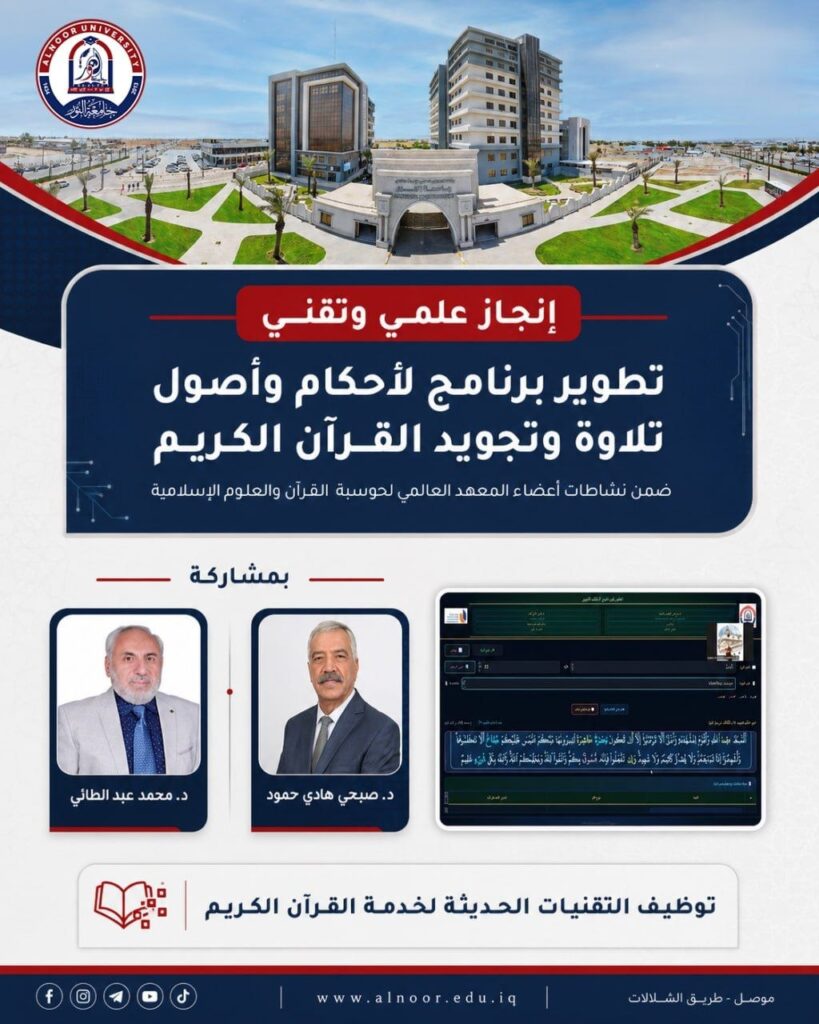
In a scientific and technological achievement that combines computer science with Islamic studies, and as part of the efforts of Alnoor University’s academic staff, Dr. Subhi Hamadi Hamdoun, Head of the Department of Cybersecurity Techniques Engineering at the Technical Engineering College of Alnoor University, in collaboration with Dr. Mohammed Hamid Altaie, a faculty member at the University of Technology and Applied Sciences in Sohar, Sultanate of Oman, contributed to the development of an advanced electronic application titled “The Rules of Quranic Tajweed.
The application relies on PHP technologies alongside artificial intelligence algorithms to analyze the Quranic text and identify the locations of Tajweed rules and principles. This includes rules such as Izhar (clear pronunciation), Idgham (assimilation), Ikhfa (concealment), Iqlab (conversion), the various types of Madd (elongation), the emphatic and non-emphatic pronunciation of the letter Ra’, and other Tajweed rulings according to the narration of Hafs ‘an Asim. The analysis is conducted at the level of individual verses, pages, surahs, and the entire Holy Quran.
The application was further developed through the integration of intelligent algorithms that contributed to designing modern and user-friendly interfaces. It also provides fast identification of Tajweed rules, their classification and organization according to their types, and displays them in distinctive colors that make it easier for users to understand and absorb them.
The application also includes a collection of audio recitations by a number of renowned Quran reciters, allowing users to select a reciter and listen to the desired verses. It also provides the option to display interpretations of the verses from Tafsir al-Jalalayn, as well as presenting their meanings in several languages, namely English, Kurdish, Turkish, and Urdu, based on the electronic versions of Quran translations issued by the King Fahd Complex for the Printing of the Holy Quran.
The application also includes an introductory section that provides a simplified explanation of the rules of Tajweed and their principles, in addition to allowing users to download the required verses, thereby enhancing the educational benefits and learning experience for users.
Within the framework of supporting the educational process, the application provides a testing and assessment program for Tajweed rules and principles at multiple levels. Users can select the appropriate level, answer a variety of randomly generated questions, and, upon completing the test, receive an electronic certificate containing their name and score.
The application has been designed to operate efficiently on smartphones and computers, providing easy access to its features and allowing users to benefit from its services at any time. It reflects the integration of modern technologies and artificial intelligence in serving the Holy Qur’an and its sciences.